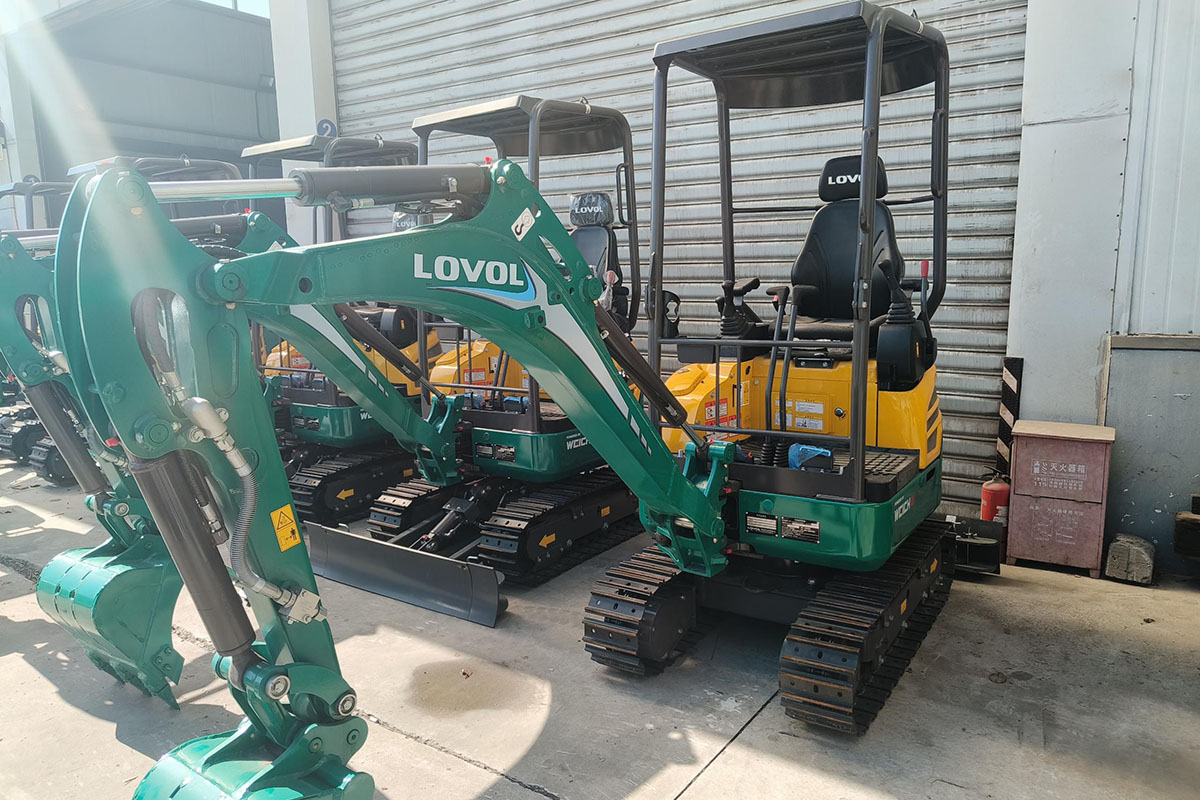
At the sprawling manufacturing campus of Hebei Maoxiang Technology, our workshop isn’t just a space for assembly—it’s a hub of precision engineering where LOVOL mini excavators (featured in Fig 2) take shape, blending compact design with industrial-grade power. These small-but-mighty machines, tailored for construction, landscaping, and urban renovation, are built with a fanatical focus on component quality, operational flexibility, and long-term durability—qualities that have made them a staple in both domestic and global markets. From raw material selection to final field testing, every step of their production is calibrated to deliver reliability in the most demanding work environments.
Raw Material & Component Sourcing: The Foundation of Durability
The production of LOVOL mini excavators begins with sourcing materials that balance strength and weight—critical for machines that need to navigate tight spaces without sacrificing power. For the main frame (the excavator’s “backbone”), we use high-strength low-alloy (HSLA) steel (compliant with GB/T 1591-2018 standards), which offers 30% higher tensile strength than conventional carbon steel while remaining 15% lighter. Each steel plate undergoes ultrasonic testing to detect internal defects, and samples are lab-tested to verify a yield strength of 420 MPa—essential for withstanding the stress of digging and lifting.
The hydraulic arms, the core of the excavator’s functionality, are forged from 40Cr alloy steel (per GB/T 3077-2015), then heat-treated to a hardness of 28-32 HRC to resist wear and deformation. Hydraulic cylinders (supplied by a Tier 1 global manufacturer) are tested for pressure resistance: each cylinder is subjected to 1.5 times its rated working pressure (31.5 MPa for standard models) for 5 minutes without leaking—a safeguard against failure during heavy digging. Even the rubber tracks (a key component for maneuverability) are sourced from suppliers meeting ISO 10451 standards; they’re reinforced with steel cords and tested for tear resistance over 10,000 cycles of operation on rough terrain.
Precision Assembly: Calibrating Every Component
Our LOVOL mini excavator production line operates with micron-level precision, overseen by engineers with 5+ years of experience in heavy machinery assembly. The hydraulic system, which dictates the excavator’s responsiveness, is assembled in a dust-free cell to prevent contamination: each valve, hose, and fitting is torque-tightened to ±2 N·m using digital wrenches, and the entire system is flushed with high-purity hydraulic oil (ISO VG 46) before testing.
The arm and bucket assembly is a masterclass in alignment: we use laser positioning tools to ensure the arm’s pivot points are aligned within 0.5mm, so the bucket moves smoothly through its 180° digging range. The bucket itself (made of wear-resistant 16Mn steel) is welded using robotic arms with a 0.2mm weld bead tolerance, then tested for load capacity: it must lift 1.2 times its rated weight (e.g., 600kg for a 500kg bucket) without bending.
Track assemblies, which determine the excavator’s stability and mobility, are calibrated to ensure equal tension on both sides—deviation of more than 5mm can cause uneven wear, so we use tension gauges to set each track to 300N of resistance. The undercarriage’s swing mechanism (which allows 360° rotation) is tested for smoothness: it must rotate a full circle in 8 seconds with no jitter, even when the arm is fully extended.
Rigorous Testing: Ensuring Field Readiness
Before a LOVOL mini excavator leaves the workshop, it undergoes a battery of tests to simulate real-world conditions—no machine is shipped until it passes every benchmark.
First is the static load test: the excavator is secured to a test bed, and the arm is extended to its maximum reach (typically 4.5m for a 1.5-ton model) while lifting a 1.5x rated load. We monitor the frame and arm for deformation using strain gauges; any deflection over 2mm results in rework.
Next is the dynamic durability test: the excavator runs 500 cycles of “dig-lift-dump” operations, using a simulated soil bed (composed of sand, gravel, and clay) to replicate construction site conditions. During this test, we track hydraulic pressure, fuel efficiency (for diesel models), and track wear—any component showing excessive wear is replaced.
Operational flexibility is tested in a purpose-built “tight space course”: the excavator must navigate a 2m-wide corridor, rotate 360° within a 3m radius, and dig a 1.5m-deep trench—tasks that mimic urban renovation or landscaping projects. For electric models (a growing segment of our LOVOL line), we test battery life: the 48V lithium-ion battery must power 4 hours of continuous digging (or 8 hours of light use) on a single charge.
Finally, every excavator undergoes a 2-hour field test at our on-site proving ground, where a certified operator evaluates performance, comfort, and safety features (including emergency stop buttons and rollover protection structures, which meet ISO 12100 standards).
Market Success: Compact Power for Global Demand
The attention to precision and durability in our workshop has made LOVOL mini excavators a favorite in both domestic and international markets. In China, they’re widely used for urban pipe-laying, garden renovation, and small-scale construction—their 1.5–3 ton weight class lets them access sites too narrow for full-size excavators, while their 15–25kW engines (or 18kW electric motors) deliver enough power to dig 2m-deep trenches or lift 1-ton loads.
Internationally, they’re gaining traction in Europe (where strict emissions standards favor our electric models) and Southeast Asia (where they’re used for agricultural land preparation and small construction projects). In 2024 alone, we exported 12,000 LOVOL mini excavators—up 28% from the previous year—thanks to their combination of compact size, low maintenance costs, and 2-year warranty (backed by our global service network).
Beyond Production: A Commitment to Performance
For us, producing LOVOL mini excavators isn’t just about assembling parts—it’s about building machines that empower workers to get more done, safely and efficiently. Every laser alignment, every load test, and every field trial in our workshop is a promise: that when a LOVOL mini excavator arrives on a job site, it’s ready to perform—no compromises.
As demand for compact, powerful machinery grows, our workshop will continue refining every detail of LOVOL mini excavator production—ensuring that these small machines keep delivering big results, one precision-built component at a time.
 EN
EN